Technical Sheet
Start and arrival: Gubbio
Distance: 20 km
Height difference: 900 metres
Difficulty: medium-hard
Surface: 70% dirt, 30% sealing
Da vedere in zona: Gubbio, Sant’Ubaldo, Gola del Bottaccione
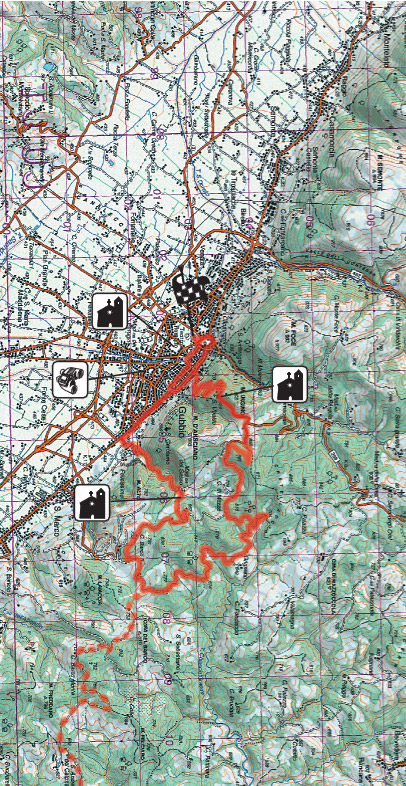
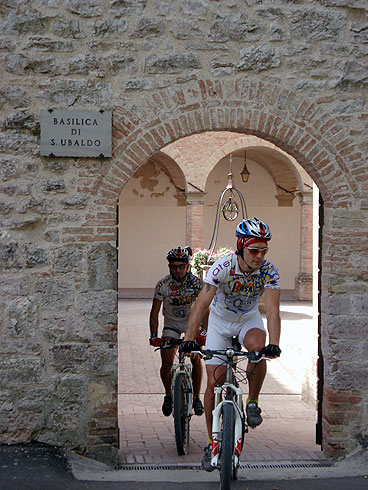
This route, of great cultural and scenic interest, starts from the Roman Amphitheatre below Gubbio and goes along the ridge that separates Gubbio from Costacciaro and Sigillo, and, before descending to the historical centre of Gubbio, reaches the interesting Basilica di Sant’Ubaldo (photo on left).
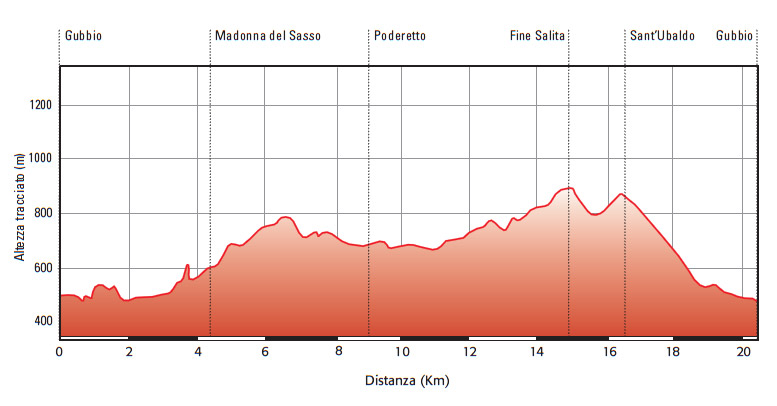
The 20km trail is not excessively long and much of it is through the woods. It has three climbs: the longest one, Madonna del Sasso, has some difficult stretches, while the other two are shorter and easier and reach more than 800m a.s.l. without any particular effort.
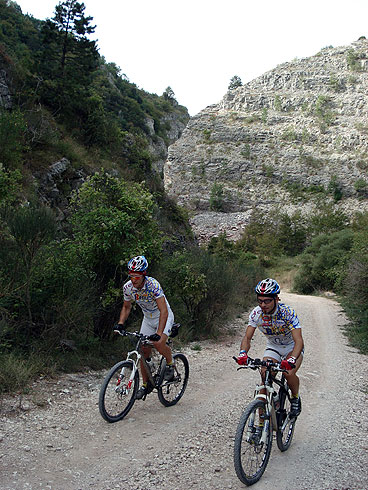
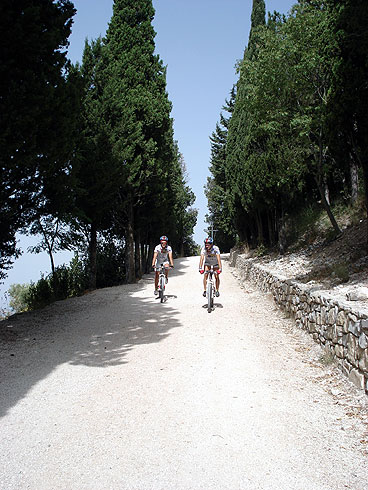
Once outside Gubbio the trail follows the sealed road to Branca to km 2,6, where it turns left towards the cemetery and begins the first climb. This dirt road climbs gently up a pretty gorge to the little church of Madonna del Sasso, at km 4,4. From here it continues straight ahead, but up a steep climb requiring lower gears. At km 5,1, after the steep stretch, it turns right and starts climbing again through shady woods to km 6,3, where the first climb ends.
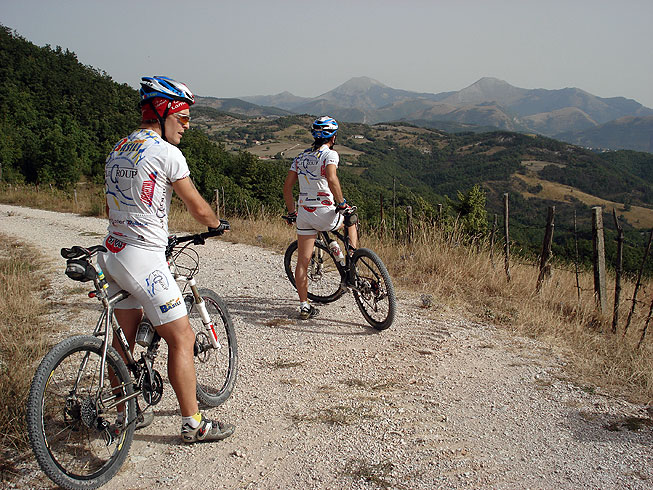
Here it turns left and continues for a few kilometres along a panoramic dirt road on the hillside which provides breathtaking views of Mt. Cucco and the Appennines between Umbria and the Marches.
Turning left at a branch in the road (km 10,5), it then starts climbing again to km 14,3, where it leaves the main road near a drinking fountain and turns right along the nature walk, through a pine forest and along an enjoyable single track for about a kilometre (those who wish to avoid this more difficult stretch can stay on the sealed road and pick up the trail a few hundred metres further on).
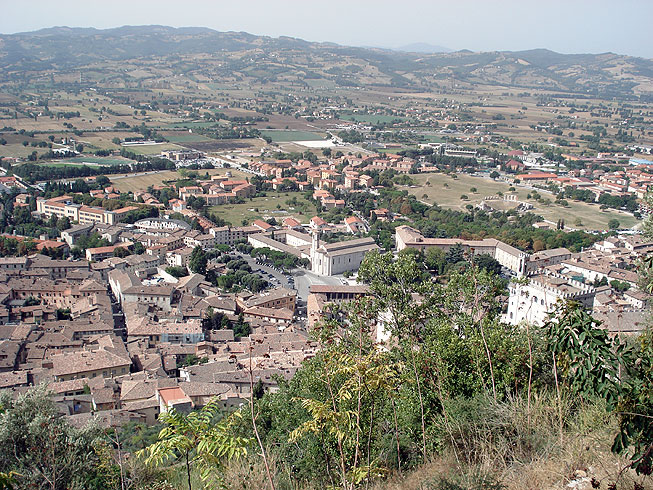
Back on the sealed road, the trail descends again for a few metres before tackling the last tough stretch that goes to the Basilica di Sant’Ubaldo, at km 16,5. From here the it goes down the dirt road that is used during the uphill race of the Ceri, providing a wonderful view of Gubbio.
The dirt road ends just above the Palazzo Ducale and the Palazzo del Duomo, descending to the centre of Gubbio, where a visit to see the hanging gardens and a stroll along corso Garibaldi are truly worthwhile before returning to the starting point.
Things not to miss
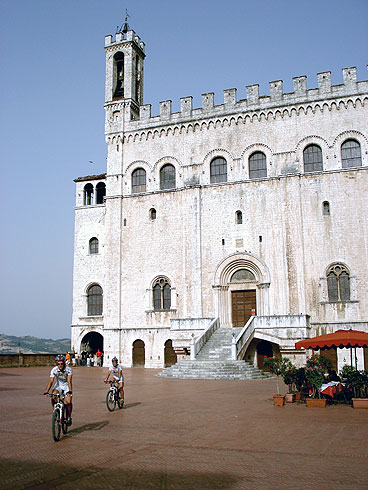
The historical centre of Gubbio, which is included both at the start and the end of the trail, a masterpiece of medieval civilisation and 13th to 14th century society. Among the architectural beauties the most famous is the palazzo dei Consoli complex (photo on right), symbol of the city and seat of the pinacoteca and archeological museum. Other important buildings are palazzo Beni, palazzo del Bargello with its famous fountain, and palazzo del Capitano del Popolo.
The Cathedral (XII century), the church of Santa Maria Nuova, containing the Madonna del Belvedere by Ottaviano Nelli, the church and convent of Sant’Agostino (XIII century) with frescos by Nelli, , the church and convent of San Francesco, the church of San Giovanni, with its Romanesque façade and belltower , and the churches of San Pietro e San Domenico are all worth a visit.
High outside the walls, overlooking the town, is the basilica di Sant’Ubaldo (the trail goes in front of this at km 16,5), which houses the saint’s body.
It ia also worth seeing Scheggia, founded by the Romans, and the nearby remains of the ancient Flaminia highway.
Around Gubbio, see the mountains between Gubbio and Mt. Cucco and two other areas of great naturalistic interest: the Mt. Cucco Park and the Gole del Bottaccione gorge, a site of world scientific interest where it is believed that there are traces of one of the key events that caused the extinction of the dinosaurs.